 The big tempest in the tiny teapot of the comic book world is DC's new Before Watchmen program, which has press-ganged some of the biggest names in comics to create mini-series based on the stars of the original Watchmen maxi-series from 1986.
 Given that the paperback collection of Watchmen still sells thousands of copies every year (it's the Dark Side of the Moon of the funnybook ghetto), such a move was inevitable.
DC tried for years to get writer Alan Moore and artist David Gibbons to do their own sequel, but Moore felt cheated by a clause in his contract that guaranteed the rights to the book would return to him after the book went out of print, seeing that it's still obviously very much in print, more than a quarter-century later.
But in DC's defense, the contract was written during the creator-cuddly Jeanette Kahn/Dick Giordano regime (if someone told me that Kahn herself gave all her freelancers backrubs when they dropped by, I wouldn't fall over in shock) and given the realities of the market back then --and Moore's cultish appeal-- there was no reason to expect that A., Watchmen would be anything but just another (floppy-based) cult hit for Moore and B., would ever be part of the industry's aggressive bookstore program, because such a thing didn't really exist at the time.
But the real issue is that Alan Moore doesn't want anyone to adapt his work. This doesn't just apply to comics; he's always good for an extraordinarily articulate anti-Hollywood screed (and an actual curse often thrown in for seasoning) whenever someone decides to adapt one of his comics, as they did with From Hell, V for Vendetta, League of Extraordinary Gentlemen and indeed, Watchmen itself (which I much prefer to the comic).
That's what the real issue is here-- it's about Alan Moore the auteur, the great bard who elevated the lowly comic book from utter disrepute. Before Watchmen is like painting a Groucho mask on the Mona Lisa.
 There's only one problem: Alan Moore's oeuvre is one of the most nakedly derivative bodies of work I can think of for an artist of his stature.
Now, let's be absolutely clear: I love Alan Moore's comic book work. I do think he's one of the greatest writers in the history of the medium. I think his League of Extraordinary Gentlemen books are hands-down the greatest comic book works in the superhero/fantasy-adventure medium, and are easily the rival of the best fantasy novels as well. He may not be as prolific as he once was, but he's still got it; 1969 wasn't the best entry in the series but it kicks the shit out of anything else out there.
But let me hand it over to J. Michael Straczynski (Babylon 5 creator and comic book superstar) who had this to say in The Hollywood Reporter:
Then there are all the Lovecraft rewrites, including the X-Files/Lovecraft fanfic of The Courtyard and Neonomicon. Now, Moore might be able to justify all of these "tributes" by pointing out that the authors he's rewriting are long dead, but what about the alive-and-well Chris Carter?
 Doggett and Scully search for Muld...oh, wait.
It's blatantly obvious that the (tall, thin, dark-haired) FBI agent "Aldo Sax"who specializes in the "Twilight Zone" cases in The Courtyard is Mulder (Sax Aldo=Fox Mulder) and the (sexy, skeptical, strawberry-blonde, pictured wearing a ginger wig in case you didn't get the hint) agent who is sent to find out what sent him over the deep end in Neonomicon is Scully.
Do you think Carter appreciates having his characters portrayed as a virulent racist and an inept sex addict (who ends up being repeatedly raped by one of the Lovecraftian aliens), respectively?
Now don't get me wrong: I enjoyed these books quite a bit but I didn't complain when reviewers dismissed Neonomicon as an X-rated X-Files parody. But what it confirms is a long-established pattern of Moore taking the work of other writers and using it as a template; a basis for which he can project his own interpretations of the characters. There's nothing wrong with that per se, especially in the hands of a writer as ingenious and prodigiously creative as Moore. It's a tradition that goes back a very long way.
But if Carter might not appreciate Moore's Mulder and Scully, what would L. Frank Baum, J.M. Barrie and Lewis Carroll make of The Lost Girls, which Moore proudly labels as pornography? Of course, it's a toss-up with Carroll but I would say that authors have the right not to have their pre-adolescent characters recreated as sex-mad harlots, whether they were alive or dead.
I won't pretend for a second that Moore's gives two shits about what I think, but he's pissing a lot of fans off, even if the elites continue to toe his line.
But given the rising skeptic/atheist virus that is sucking all of the creativity out of Geekdom, you would think Moore would want to fly the flag more responsibly, not only for heretical thinking but for the concept of a strong and autonomous creator, something that is dying away in genre entertainment.
I get the very strong impression Moore doesn't care about any of that, though. He's always seen comics fandom the way you or I would see dogshit on our shoes. If they all see ritual magicians as total cranks because of Moore's actions, it's all the same to him.

But in many ways Before Watchmen is a troubling symptom of the collapse of creativity in what should be a raging hothouse for ideas. Comics are so cheap to produce and the Internet has made them accessible to a larger audience than ever before, but a generation that has been so aggressively socialized as the Millennials (with some brave and notable exceptions, mind) seem absolutely terrified to make its own mark. They're perfectly content to remain consumers, since producing something like Watchmen means you have to step away from the herd and break the rules, something very few of them are willing to risk.
DC held out for a long time out of respect for (if nothing else) Moore's reputation, but with the bookstore market in tatters and nothing like Watchmen, Dark Knight or Sandman in the pipeline, they have no choice but to tap the well once again. I don't expect any of these books to have anything like the same impact but they'll do well if they avoid another Dark Knight Strikes Again debacle.
But Fandom loves its costless self-righteous outrage, so anytime a creator and a publisher come to blows, you know whose side they'll take. I have no dog in this fight, other than the fact that I think Moore's behavior is reinforcing some negative stereotypes that have done tremendous damage to the cause of creativity in pop culture.
But then again, maybe it's much too late to worry about that anymore.
DC tried for years to get writer Alan Moore and artist David Gibbons to do their own sequel, but Moore felt cheated by a clause in his contract that guaranteed the rights to the book would return to him after the book went out of print, seeing that it's still obviously very much in print, more than a quarter-century later.
But in DC's defense, the contract was written during the creator-cuddly Jeanette Kahn/Dick Giordano regime (if someone told me that Kahn herself gave all her freelancers backrubs when they dropped by, I wouldn't fall over in shock) and given the realities of the market back then --and Moore's cultish appeal-- there was no reason to expect that A., Watchmen would be anything but just another (floppy-based) cult hit for Moore and B., would ever be part of the industry's aggressive bookstore program, because such a thing didn't really exist at the time.
But the real issue is that Alan Moore doesn't want anyone to adapt his work. This doesn't just apply to comics; he's always good for an extraordinarily articulate anti-Hollywood screed (and an actual curse often thrown in for seasoning) whenever someone decides to adapt one of his comics, as they did with From Hell, V for Vendetta, League of Extraordinary Gentlemen and indeed, Watchmen itself (which I much prefer to the comic).
That's what the real issue is here-- it's about Alan Moore the auteur, the great bard who elevated the lowly comic book from utter disrepute. Before Watchmen is like painting a Groucho mask on the Mona Lisa.
 There's only one problem: Alan Moore's oeuvre is one of the most nakedly derivative bodies of work I can think of for an artist of his stature.
Now, let's be absolutely clear: I love Alan Moore's comic book work. I do think he's one of the greatest writers in the history of the medium. I think his League of Extraordinary Gentlemen books are hands-down the greatest comic book works in the superhero/fantasy-adventure medium, and are easily the rival of the best fantasy novels as well. He may not be as prolific as he once was, but he's still got it; 1969 wasn't the best entry in the series but it kicks the shit out of anything else out there.
But let me hand it over to J. Michael Straczynski (Babylon 5 creator and comic book superstar) who had this to say in The Hollywood Reporter:
The perception that these characters shouldn't be touched by anyone other than Alan is both absolutely understandable and deeply flawed. As good as these characters are – and they are very good indeed – one could make the argument, based on durability and recognition, that Superman is the greatest comics character ever created. But I don't hear Alan or anyone else suggesting that no one other than Shuster and Siegel should have been allowed to write Superman. Certainly Alan himself did this when he was brought on to write Swamp Thing, a seminal comics character created by Len Wein.
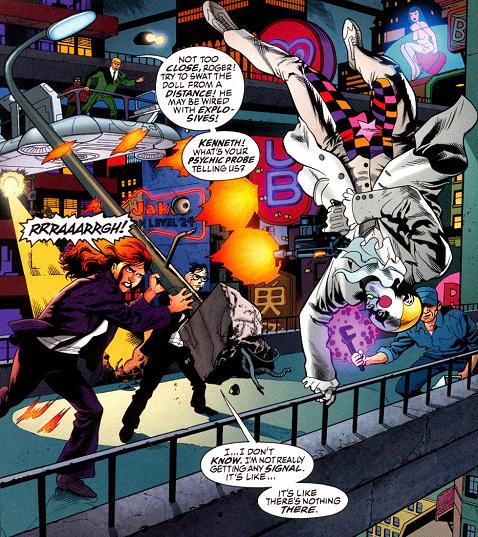
Leaving aside the fact that the Watchmen characters were variations on pre-existing characters created for the Charlton Comics universe, it should be pointed out that Alan has spent most of the last decade writing very good stories about characters created by other writers, including Alice (from Alice in Wonderland), Dorothy (from Wizard of Oz), Wendy (from Peter Pan), as well as Captain Nemo, the Invisible Man, Jeyll and Hyde, and Professor Moriarty (used in the successful League of Extraordinary Gentlemen).I'd throw in Simon and Kirby (First American is a blatant Fightin' American clone), Will Eisner (Greyshirt=The Spirit), and Jack Cole (Splash Brannigan=Plastic Man). There's also the fact that Tom Strong is a blatant Doc Savage clone and Promethea is obviously Moore's take on Wonder Woman (Moore doesn't even bother to hide that her nemesis the Painted Doll is the Joker).
I think one loses a little of the moral high ground to say, "I can write characters created by Jules Verne, H.G. Wells, Robert Louis Stevenson, Arthur Conan Doyle and Frank Baum, but it's wrong for anyone else to write my characters."
Then there are all the Lovecraft rewrites, including the X-Files/Lovecraft fanfic of The Courtyard and Neonomicon. Now, Moore might be able to justify all of these "tributes" by pointing out that the authors he's rewriting are long dead, but what about the alive-and-well Chris Carter?
 Doggett and Scully search for Muld...oh, wait.
It's blatantly obvious that the (tall, thin, dark-haired) FBI agent "Aldo Sax"who specializes in the "Twilight Zone" cases in The Courtyard is Mulder (Sax Aldo=Fox Mulder) and the (sexy, skeptical, strawberry-blonde, pictured wearing a ginger wig in case you didn't get the hint) agent who is sent to find out what sent him over the deep end in Neonomicon is Scully.
Do you think Carter appreciates having his characters portrayed as a virulent racist and an inept sex addict (who ends up being repeatedly raped by one of the Lovecraftian aliens), respectively?
Now don't get me wrong: I enjoyed these books quite a bit but I didn't complain when reviewers dismissed Neonomicon as an X-rated X-Files parody. But what it confirms is a long-established pattern of Moore taking the work of other writers and using it as a template; a basis for which he can project his own interpretations of the characters. There's nothing wrong with that per se, especially in the hands of a writer as ingenious and prodigiously creative as Moore. It's a tradition that goes back a very long way.
But if Carter might not appreciate Moore's Mulder and Scully, what would L. Frank Baum, J.M. Barrie and Lewis Carroll make of The Lost Girls, which Moore proudly labels as pornography? Of course, it's a toss-up with Carroll but I would say that authors have the right not to have their pre-adolescent characters recreated as sex-mad harlots, whether they were alive or dead.
I won't pretend for a second that Moore's gives two shits about what I think, but he's pissing a lot of fans off, even if the elites continue to toe his line.
But given the rising skeptic/atheist virus that is sucking all of the creativity out of Geekdom, you would think Moore would want to fly the flag more responsibly, not only for heretical thinking but for the concept of a strong and autonomous creator, something that is dying away in genre entertainment.
I get the very strong impression Moore doesn't care about any of that, though. He's always seen comics fandom the way you or I would see dogshit on our shoes. If they all see ritual magicians as total cranks because of Moore's actions, it's all the same to him.

But in many ways Before Watchmen is a troubling symptom of the collapse of creativity in what should be a raging hothouse for ideas. Comics are so cheap to produce and the Internet has made them accessible to a larger audience than ever before, but a generation that has been so aggressively socialized as the Millennials (with some brave and notable exceptions, mind) seem absolutely terrified to make its own mark. They're perfectly content to remain consumers, since producing something like Watchmen means you have to step away from the herd and break the rules, something very few of them are willing to risk.
DC held out for a long time out of respect for (if nothing else) Moore's reputation, but with the bookstore market in tatters and nothing like Watchmen, Dark Knight or Sandman in the pipeline, they have no choice but to tap the well once again. I don't expect any of these books to have anything like the same impact but they'll do well if they avoid another Dark Knight Strikes Again debacle.
But Fandom loves its costless self-righteous outrage, so anytime a creator and a publisher come to blows, you know whose side they'll take. I have no dog in this fight, other than the fact that I think Moore's behavior is reinforcing some negative stereotypes that have done tremendous damage to the cause of creativity in pop culture.
But then again, maybe it's much too late to worry about that anymore.